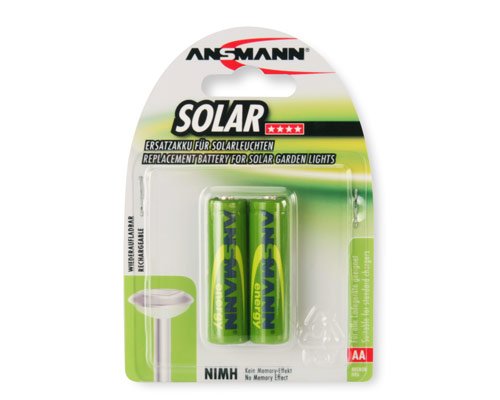
Most batteries are bought in a hurry, at a checkout, one blister at a time — and most of them are the wrong cell for the job. Understanding four things on the label (size, chemistry, capacity and voltage) is enough to stop wasting money and to stop damaging the devices that depend on them. This guide covers the formats you will find in a European household: AA, AAA, C, D, 9V and button cells, in alkaline, NiMH and lithium.
What the label actually says
Four pieces of information matter, and three of them are usually ignored.
- Size code — AA, AAA, C, D or a four-digit number on a button cell. This is physical: a wrong size does not fit, which at least fails safely.
- Chemistry — alkaline, NiMH (rechargeable), lithium or silver oxide. This decides voltage behaviour and whether the cell can be recharged at all.
- Capacity in mAh — how much charge it holds. Only comparable between cells of the same chemistry and size.
- Voltage — 1,5 V for alkaline, 1,2 V for NiMH, 3 V or 3,7 V for lithium and coin cells. This is where devices break.
A NiMH AA delivers 1,2 V where an alkaline delivers 1,5 V. Most devices tolerate it; a few — some bike lights, some older cameras — do not, and behave as if the battery were flat from the first minute.
Alkaline, NiMH or lithium
The choice is not about quality. It is about how the device is used.
- Alkaline suits low-drain items used rarely: remotes, wall clocks, kitchen scales, smoke detectors. It holds charge for years on a shelf and costs little.
- NiMH suits anything used weekly and heavily: toys, game controllers, camera flashes, beard trimmers. The higher upfront price is recovered in a handful of cycles.
- Lithium AA is for extremes — cold, or long unattended periods. It costs several times an alkaline and makes sense in a device you will not open for two years.
One practical note that surprises people: a modern low-self-discharge NiMH cell, charged and left in a drawer, keeps most of its charge for a year. The old advice that rechargeables go flat on the shelf no longer applies to that type.
Button cells: read the code, do not guess
A button cell is identified by a four-digit code, and swapping one digit changes the thickness or the chemistry. Two cells can look identical and differ by 0,2 mm or by 1,5 V versus 3 V.
- CR2032 — 20 mm diameter, 3,2 mm thick, lithium, 3 V. Remotes, key fobs, motherboards.
- LR44 / AG13 — alkaline, 1,5 V. Small toys, some thermometers.
- SR626SW — silver oxide, 1,55 V. Watches, where a stable voltage matters.
The rule is simple: take the old cell out and read it. Never substitute a 3,7 V lithium cell for a 3 V coin cell, and never mix an alkaline with a silver oxide in the same device.
What a charger has to do
A charger is not a commodity. Two features separate a unit that protects your cells from one that quietly destroys them.
- Independent channels — a four-bay charger with one circuit charges in pairs, so a half-empty cell is overcharged while its partner is still filling. Four independent slots avoid this.
- Cut-off on voltage, not on a timer — a timer-based charger keeps pushing current into a full cell. Look for −dV or temperature cut-off.
Refresh or discharge modes are useful for reviving cells that have been stored flat, but they are a secondary feature. If you buy one thing, buy independent channels.
Storing, mixing and disposing
Store cells at room temperature, out of the device if it will sit unused for months, and never store them loose in a drawer with keys or coins — a short across a 9V terminal gets hot enough to be a fire risk. Do not mix chemistries, brands or states of charge in the same device: the weakest cell is driven below its safe voltage and leaks.
Leaking alkaline cells are the most common cause of dead electronics. If a device has been sitting with cells inside, remove them before storing it. Spent batteries are collected separately across the EU and should never go in household waste.
Choosing in one minute
Remote or clock: alkaline AA or AAA. Weekly-used toy or controller: NiMH AA with a four-channel charger. Hearing aid or watch: the exact button code printed on the old cell. Smoke detector: the cell specified in its manual, replaced on schedule rather than when it starts chirping.
Where to buy: browse the full range in our batteries and chargers collection, compare portable power in power banks and chargers, or find mains adapters in phone and tablet chargers.
14-day returns, a 2-year EU warranty and prices in EUR on every listing.
This week's verified stock
Products in stock, at the price shown. 14-day returns, 2-year warranty, delivery in 3-7 business days within the EU and 1-3 in Spain and Portugal.